How to Choose a Safety Light Curtain for Your Machine?
Choosing a Safety Light Curtain is not a matter of selecting the longest sensing range. It is a risk-control decision involving access points, stopping time, resolution, environment, and control architecture. The U.S. Bureau of Labor Statistics reported 2.6 million nonfatal workplace injuries and illnesses in private industry during 2023. That figure does not isolate light-curtain incidents, but it shows why machine safeguarding deserves careful engineering.
William Haddon Jr., a leading injury-prevention expert, described injury as “the transfer of energy to the body in amounts or at rates that exceed tolerance.” A properly selected Safety Light Curtain helps interrupt that energy transfer before a hand or body reaches the hazard. However, it cannot compensate for poor guarding, an unsafe restart circuit, or inaccurate stopping-time measurements. Small details matter. A 14 mm resolution may suit finger detection, while a larger resolution may only detect a hand or arm.
This guide examines the practical selection process. It considers IEC 61496 requirements, EN ISO 13849-1 performance levels, OSHA machine-guarding guidance, and the actual geometry of your machine. Measure the danger zone. Check the brake response. Inspect dust, vibration, welding flash, and reflective surfaces. Then verify the safety distance using measured values, not assumptions. No checklist is perfect. A light curtain can look correct during installation and still fail during maintenance or reset. The safest choice combines documented risk assessment, compatible safety controls, validated installation, and routine testing.
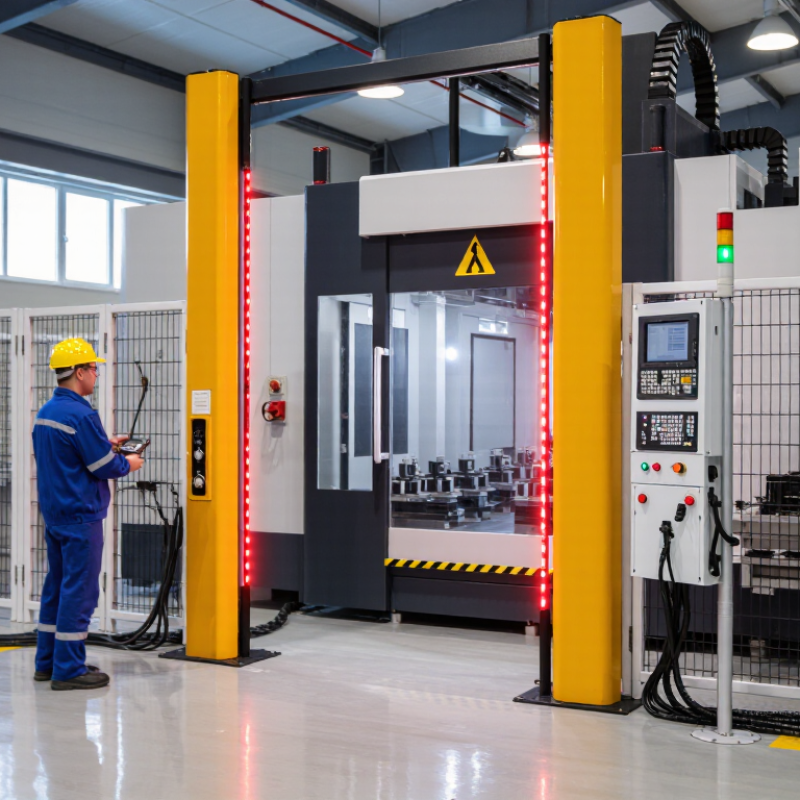
Define the Hazard and Required Safety Level Under ISO 13849-1
Choosing a safety light curtain starts with the hazard, not the sensor catalogue. Observe the machine during loading, cleaning, adjustment, and fault recovery. Identify crushing, shearing, cutting, and unexpected movement zones. Record who can enter the danger area and how often.
Under ISO 13849-1, estimate the required Performance Level, or PLr, from severity of injury, exposure frequency, and the possibility of avoiding harm. A light curtain may need a higher PLr when operators enter repeatedly and machine motion stops slowly. Measure the total stopping time, including control delay, valve response, and mechanical braking. Then calculate the minimum safety distance. Check the curtain’s Category, MTTFd, DCavg, and common-cause failure controls as part of the complete safety function. Do not rate the curtain alone. The wiring, safety controller, and final switching devices matter too. I have seen designs fail because real stopping data was replaced with a generous estimate.
Tips: Measure stopping time with a calibrated device at the worst operating condition. Allow for tool changes, wear, and low air pressure. Select resolution according to the body part that could reach the hazard. Finger detection is not enough if an arm can enter above or around the field. Check access from the rear and side. A reflective surface can create confusion. Test it on the actual machine. Then document the assumptions, because one overlooked access route can change the required PLr.
Choose Type 2 or Type 4 Protection Under IEC 61496-1/-2
How to Choose a Safety Light Curtain for Your Machine?
A light curtain is not chosen by reach alone. IEC 61496-1 and IEC 61496-2 define Type 2 and Type 4 requirements for electro-sensitive protective equipment. Type 2 devices use periodic testing and less stringent fault detection. They may suit lower-risk applications after a documented assessment. Type 4 devices apply stricter fault detection and higher performance requirements. They are normally preferred where unexpected access could cause serious injury.
Start with ISO 12100 risk assessment, not a catalogue table. Check stopping time, minimum object sensitivity, hazardous-zone access, and machine overrun. A curtain with 14 mm resolution may detect a finger, but it cannot protect an opening that workers can walk around. Mounting distance matters. So does reset control.
2.6 million
The U.S. Bureau of Labor Statistics reported 2.6 million nonfatal workplace injuries and illnesses in private industry during 2023.
138 worker fatalities
The UK Health and Safety Executive recorded 138 worker fatalities in 2023/24.
These figures do not prove that every incident needs Type 4 protection, but they justify careful verification.
In practice, Type 4 is often the safer engineering choice for presses, robotic cells, and high-energy machinery. Still, “higher type” is not a substitute for guarding design. Confirm compatibility with the control system, test functions, environmental conditions, and required performance level under ISO 13849-1.
I have seen projects specify Type 4 too early, then discover poor access control and incorrect stopping-distance calculations. The light curtain was compliant. The safeguarding system was not.
Calculate the Minimum Safety Distance Using ISO 13855
How to Choose a Safety Light Curtain for Your Machine?
Choosing a safety light curtain begins with the required safety distance. Mounting space is not the starting point. ISO 13855 provides a method for calculating this distance between the hazard and the sensing field. Measure the complete stopping time, including the machine brake, control circuit, and safety output device. A stopwatch alone is not reliable enough. Use suitable stopping-time equipment and test the machine under realistic conditions.
The basic calculation is S = K × T + C. Here, S is the minimum safety distance in millimetres. K represents the approach speed, while T is the total stopping time in seconds. C accounts for intrusion through the light curtain and depends on its resolution and application. For example, with a 30 mm resolution, a 0.18-second stopping time, and K of 2,000 mm/s, C may be 128 mm under the applicable condition. The result is S = 488 mm. Confirm the correct approach speed and correction value for your machine.
A neat calculation can still mislead. Brake wear, heavy loads, temperature, and pressure changes may increase stopping time. Test several cycles, including the worst practical condition. Check the distance from the danger point, not merely from the curtain housing. Guarding may also be necessary if an operator can reach around, over, or beneath the sensing field. Recheck the calculation after changing speed, tooling, software, or maintenance settings. Small assumptions create large gaps.
How to Choose a Safety Light Curtain for Your Machine?
Minimum Safety Distance Calculated Using ISO 13855
Calculation basis: The chart uses the ISO 13855 formula
S = K × T + C, where S is the minimum safety distance,
K = 1,600 mm/s is the assumed approach speed,
T is the total system stopping time, and
C = 128 mm is the intrusion distance for a nominal 30 mm detection resolution.
The values are an engineering example and must be verified using the actual machine stopping time,
approach direction, detection resolution, and risk assessment.
Match Resolution, Range, Response Time, and Machine Speed
Choosing a safety light curtain begins with the hazard, not the catalog. Resolution must detect the smallest body part that could reach the danger zone. Finger detection often requires about 14 mm resolution, while hand detection commonly uses 30 mm. ISO 13855 requires the safety distance to reflect access speed, system response time, and intrusion depth.
A useful calculation
S = K × T + C
Small errors matter.
Range should cover the opening without forcing the receiver beyond its rated operating distance. Dust, vibration, reflective metal, and changing alignment can reduce practical reliability. IEC 61496-1 defines performance requirements for electro-sensitive protective equipment, but the machine environment still demands testing. Check the curtain’s effective range, minimum object sensitivity, restart behavior, and fault indication during commissioning.
Response time must match the machine’s stopping performance, not just the curtain specification. Measure the complete chain: light curtain, safety controller, contactors, drive, and mechanical brake. Then compare the result with the machine’s fastest hazardous motion.
The U.S. Bureau of Labor Statistics recorded 5,283 fatal occupational injuries in 2023, showing why verified safeguarding remains essential. The Liberty Mutual Workplace Safety Index has also reported tens of billions of dollars in annual direct workplace injury costs in the United States.
Numbers do not replace measurements. I have seen installations pass a basic test yet fail when braking distance increased with load. Recheck it under real production conditions.
Verify Installation, Muting, Reset, and Validation Requirements
How to Choose a Safety Light Curtain for Your Machine?
Verify Installation, Muting, Reset, and Validation Requirements
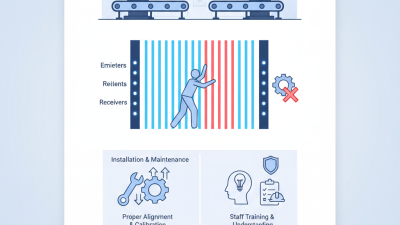
Choosing a safety light curtain starts with the machine’s actual hazards, not its catalog dimensions. Measure the hazardous opening, stopping time, approach speed, and required safety distance. The sensing field must cover every access point, including gaps beneath and beside the frame. Check alignment after mounting, because vibration can create an invisible failure. Small details matter.
Muting requires stricter review. It should operate only during a controlled material transfer, never during ordinary worker access. Use suitable sensors, defined timing, and a fault response that stops the machine. Reset controls belong outside the danger zone, with a clear view of the entire area. A reset must not restart motion automatically. The operator should understand what the reset confirms.
Validation is where many installations become weak. A qualified person should test interruption at multiple points, inspect stopping performance, and confirm that muting cannot bypass protection unexpectedly. Test power recovery, sensor faults, misalignment, and blocked access. Record each result, including the test method and measured stop time. I have seen teams trust the indicator light too much. It proves very little by itself.
Review the assessment after tooling, software, or production changes. Even a minor fixture can alter access. A checklist helps, but it can still miss real behavior. Observe the machine during normal work, unusual loading, and maintenance preparation. Then correct the design before operators adapt to unsafe habits.