Leave Your Message
-
Phone
-
E-mail
Choosing the right Lidar Laser begins with the measurement task, not the product brochure. A warehouse robot needs reliable short-range detection between metal shelves. An autonomous vehicle needs longer range, wider coverage, and stable performance under rain, dust, and bright sunlight. These demands place very different pressures on wavelength, pulse energy, beam divergence, scan rate, and receiver sensitivity.
Industry data shows why this decision matters. McKinsey’s analysis, “Lidar for Autonomous Driving: The Future Is Now,” estimates that the automotive lidar market could grow from about $1.4 billion in 2022 to $4.5 billion by 2030. Yole Group’s lidar market research also identifies solid-state designs, lower costs, and improved automotive reliability as major development priorities. Growth is impressive. Yet, it can encourage rushed purchasing decisions.
A higher specification is not automatically better. A 1550 nm Lidar Laser may support higher permissible optical power than many 905 nm systems, but it can require more expensive sources and detectors. A 905 nm unit may provide a practical balance for industrial mapping, robotics, and compact sensing. The correct choice depends on target reflectivity, atmospheric conditions, eye-safety requirements, scanning geometry, and total system cost. IEC 60825-1 compliance should be verified through supplier documentation and independent testing where appropriate.
In practical evaluation, request raw point-cloud samples, not only range claims. Test a black surface, wet pavement, and reflective signage. Measure detection stability at the actual mounting height. Small details matter. A careless assumption about sunlight or vibration can undermine an otherwise excellent design. This guide examines the technical, operational, and commercial factors that help engineers choose a dependable Lidar Laser for their project.

How to Choose the Right Lidar Laser for Your Project?
Before selecting a lidar laser, define exactly what your system must measure. Set clear targets for range, accuracy, resolution, scan rate, and detection speed. A warehouse mapping system needs different performance from a roadside monitoring system. Record the smallest object you must detect, not just the maximum distance. Dark rubber, wet asphalt, glass, and dusty air can weaken returns. Test these surfaces when possible. Laboratory figures may not reflect field conditions.
Your measurement requirements should also include environmental limits. Note temperature, humidity, vibration, sunlight, and expected operating hours. If targets move, calculate the required update rate and exposure time. If the laser works near people, confirm applicable safety requirements and obtain reliable safety data. Check calibration methods, measurement uncertainty, and technical support before approval. A strong specification should be reviewed by an experienced engineer. My first estimate is rarely perfect, so I leave room for real-world testing.
Tips: Write requirements in measurable terms. Use “±10 millimeters at 30 meters,” not “high accuracy.” Test the intended target materials. Compare results across several distances. Keep a record of failed measurements. They often reveal more than successful trials. Choose enough performance for the task, but avoid paying for unused capability.
Use this planning table to convert the measurement objective into laser specifications. Values shown are typical engineering ranges or design targets; the final selection must be verified against the receiver architecture, atmospheric conditions, applicable laser-safety requirements, and the complete system link budget.
| Measurement Dimension | Project Requirement to Define | Typical Lidar Design Range or Target | How It Affects Laser Selection | What to Confirm Before Purchase |
|---|---|---|---|---|
| Measurement objective | What physical quantity must be measured? | DetectionRange, presence, height, concentration, velocity, or surface profile | Range measurement commonly uses time of flight; velocity measurement requires a coherent or frequency-stable source; atmospheric sensing may require wavelength-specific absorption. | Define the target, measured variable, required accuracy, and acceptable false-alarm rate. |
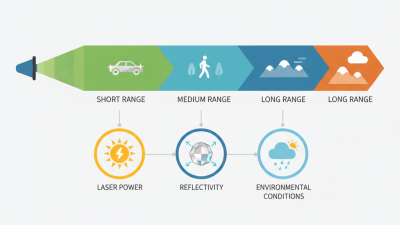
| Operating distance | Minimum, nominal, and maximum measurement range | Short range: below 100 m Medium range: 100 m–1 km Long range: above 1 km |
Longer range generally requires higher pulse energy, better beam quality, lower optical loss, greater receiver sensitivity, or a combination of these factors. | Calculate the link budget using target reflectivity, atmospheric attenuation, receiver aperture, and required detection probability. |
| Range resolution | Smallest separation between two targets that must be resolved | For pulsed time-of-flight lidar: 1 ns ≈ 15 cm one-way range resolution 10 ns ≈ 1.5 m one-way range resolution |
Shorter optical pulses improve range resolution, but they can reduce pulse energy and increase peak-power and bandwidth demands. | Specify whether the requirement refers to pulse-limited resolution, sampled resolution, or total system accuracy. |
| Update rate | How quickly must the system produce a new measurement? | Single-shot to several kHz, depending on range, scan pattern, and signal averaging | A higher pulse-repetition frequency increases measurement opportunities but may create range ambiguity if echoes from one pulse overlap with the next. | For unambiguous pulsed ranging, compare the repetition interval with the round-trip travel time to the maximum range. |
| Laser wavelength | Which spectral region provides the required target response, atmospheric transmission, or absorption contrast? | Visible wavelengths for some eye-safe short-range applications; near-infrared wavelengths for many ranging systems; longer infrared wavelengths for selected atmospheric or thermal applications | Wavelength affects eye safety, detector sensitivity, solar background, atmospheric transmission, target reflectivity, and component availability. | Model atmospheric transmission and target reflectance for the complete operating environment, not only clear laboratory conditions. |
| Eye-safety requirement | Can the transmitted beam be exposed to people, vehicles, aircraft, or animals? | Select a wavelength and pulse format that can meet the applicable accessible-emission limit for the intended classification. | Eye-safety limits depend on wavelength, pulse duration, repetition rate, beam diameter, divergence, exposure time, and accessible energy—not wavelength alone. | Perform a formal laser-safety assessment to the applicable regional standard before field deployment. |
| Pulse energy and peak power | How much returned signal is required at the maximum range? | Short-range systems may use low pulse energy; long-range systems often require substantially higher pulse energy or extensive signal averaging. | Higher pulse energy improves link margin but can increase eye-safety risk, thermal load, optical damage risk, and power consumption. | Specify pulse energy, pulse duration, peak power, average power, and allowable energy variation separately. |
| Beam divergence | How large may the beam footprint become at the target? | Low divergence for long-range energy concentration; wider divergence for broader coverage or reduced irradiance | At a given distance, beam diameter is approximately the initial beam diameter plus distance multiplied by divergence angle. Divergence also affects eye-safety calculations and scan coverage. | Balance target illumination, pointing uncertainty, receiver field of view, safety limits, and required spatial coverage. |
| Beam quality | How efficiently must the beam be focused or scanned? | A beam-quality factor close to the diffraction-limited value is preferred for long-distance focusing and narrow scan spots. | Poor beam quality enlarges the far-field spot, lowers irradiance, and can limit the useful range even when nominal output power is high. | Request beam-quality data at the operating pulse energy, repetition rate, and temperature—not only under low-power test conditions. |
| Wavelength stability | How sensitive is the measurement to wavelength drift or spectral linewidth? | Broadband ranging can tolerate more drift; Doppler, coherent, and differential-absorption measurements require tighter spectral control. | Frequency drift can introduce velocity error, reduce heterodyne efficiency, or move the source away from a desired molecular absorption feature. | Define center-wavelength tolerance, linewidth, frequency noise, warm-up behavior, and temperature coefficient. |
| Polarization | Does the target or receiver depend on polarization? | Linear polarization for polarization-sensitive atmospheric or surface measurements; polarization-maintaining performance where receiver alignment requires it | Polarization extinction and stability influence return-signal interpretation and coupling efficiency through polarization-selective optics. | State the required polarization state, extinction ratio, stability over temperature, and response after scanning optics. |
| Atmospheric environment | What weather and transmission conditions must be supported? | Clear air, haze, dust, fog, rain, snow, or smoke, depending on the deployment site | Aerosols and precipitation can attenuate and backscatter the beam. A wavelength that performs well in clear air may not provide the required margin in fog or dust. | Use site-specific visibility and attenuation assumptions, and define whether operation is required during adverse weather. |
| Target properties | What are the target reflectivity, size, texture, and orientation? | Diffuse surfaces generally return less concentrated signal than retroreflective or highly reflective targets; dark, angled, or wet surfaces can be challenging. | Target return strength determines the needed pulse energy, aperture, detector sensitivity, averaging time, and wavelength. | Test representative target materials across the expected angle, distance, and environmental range. |
| Scanning and field of view | What angular coverage and point density are required? | Fixed line of sight, raster scan, rotating scan, or wide-area flash illumination | Scanning divides available measurement time among directions. Higher angular coverage or point density may require higher pulse rate, faster switching, or multiple transmit channels. | Calculate dwell time per point, scan repetition rate, angular resolution, and the resulting pulse count per target. |
| Timing and synchronization | How accurately must transmit and receive events be synchronized? | Nanosecond-scale timing is commonly relevant to centimeter-to-meter-class pulsed ranging; coherent systems may require substantially tighter phase or frequency synchronization. | Trigger jitter and detector timing uncertainty contribute directly to range or velocity error. | Specify trigger jitter, optical pulse timing stability, detector response time, and clock synchronization method. |
| Thermal and electrical limits | What power, cooling, size, and duty-cycle constraints apply? | Portable systems favor low average power and compact thermal management; fixed long-range systems can support larger cooling and power budgets. | Average optical power, repetition rate, wall-plug efficiency, and heat dissipation affect reliability and continuous operating time. | Confirm operation at the full duty cycle over the complete ambient-temperature range. |
| Reliability and lifetime | How long must the lidar operate with stable performance? | Define operating hours, start-stop cycles, allowable power drift, and maintenance interval for the application. | High peak power, thermal cycling, contamination, vibration, and optical damage can reduce lifetime or calibration stability. | Request lifetime data, environmental test results, power-stability limits, and a defined calibration procedure. |
| System integration | How will the laser connect to the transmitter, scanner, receiver, and control electronics? | Electrical trigger, optical synchronization, fiber delivery, free-space output, or integrated driver and monitoring interfaces | Mechanical interfaces, beam height, connector type, trigger logic, warm-up time, and monitoring signals can determine whether integration is practical. | Confirm dimensions, mounting datum, optical interface, trigger requirements, software controls, and built-in safety interlocks. |