What is the Best Lidar Laser Technology for Global Buyers?
The Lidar Laser market is evolving rapidly. As global industries seek precision and accuracy, choosing the best Lidar Laser technology becomes crucial. Various applications demand different features, creating a diverse marketplace.
Manufacturers offer a range of Lidar Laser solutions that cater to specific needs. Factors like distance measurement, resolution, and operational environment greatly impact performance. Buyers must evaluate these aspects carefully. Not all technologies suit every application.
Understanding the technology landscape is essential for informed decisions. Some companies may lack clarity on product specifications. Confusion might arise from excessive marketing jargon. Hence, buyers should rely on expert reviews and technical comparisons. This knowledge helps avoid costly mistakes. The right choice in Lidar Laser technology can lead to significant advancements in sectors like mapping, forestry, and urban planning.

Types of Lidar Laser Technologies Available in the Market
Lidar technology has significantly evolved, offering various types suitable for different applications. Generally, Lidar can be categorized into airborne, terrestrial, and mobile systems. Airborne Lidar employs drones or aircraft for large-scale mapping. It excels in covering extensive areas, making it ideal for topographic surveys.
Terrestrial Lidar is designed for ground-based measurements. This technology is often used in construction and civil engineering projects. It captures high-resolution data, allowing for precise modeling. Mobile Lidar systems, mounted on vehicles, provide rapid data collection while in motion. They are particularly useful for road safety assessments and urban mapping.
Each type of Lidar technology has its strengths and weaknesses. Airborne systems may be costlier due to equipment and operational needs. Terrestrial systems require stable conditions for accurate measurements. Mobile systems can encounter difficulties in densely populated areas with obstacles. Understanding these factors is crucial for effective application across diverse scenarios.
What is the Best Lidar Laser Technology for Global Buyers?
| Lidar Type |
Wavelength (nm) |
Range (km) |
Accuracy (cm) |
Applications |
| Airborne Lidar |
1064 |
5-10 |
5 |
Topographic mapping, forestry |
| Terrestrial Lidar |
1550 |
0.5-2 |
3 |
Construction, archaeology |
| Mobile Lidar |
532 |
2-5 |
5 |
Road surveying, asset management |
| Spaceborne Lidar |
1064 |
100-200 |
10 |
Global elevation, climate change studies |
| Bathymetric Lidar |
532 |
1-3 |
15 |
Coastal surveys, underwater mapping |
Key Factors to Consider When Choosing Lidar for Global Applications
When selecting lidar technology for global applications, several key factors play a crucial role.
Accuracy is paramount.
High-resolution data can enhance decision-making processes, especially in sectors like agriculture
and urban planning. Different lidar systems provide varying levels of precision depending on their design
and intended use. Buyers must evaluate their specific needs before making a choice.
Range is another important factor. Lidar systems have different operational ranges that affect how well they perform in various environments.
Consideration of terrain and atmospheric conditions is vital. Some lidar systems may struggle in dense urban areas or heavily vegetated regions.
The weight and portability of devices also matter. A lighter lidar system can offer greater flexibility for fieldwork, particularly in remote areas.
Cost and maintenance cannot be overlooked. Budget constraints can limit options. However, it is essential to think long-term.
Cheaper systems may incur higher costs due to maintenance or data accuracy issues. Ensure that a balance exists between initial investment and operational efficiency.
These aspects require thoughtful reflection as they directly influence project outcomes and overall satisfaction.
Comparative Analysis of Leading Lidar Laser Brands and Models
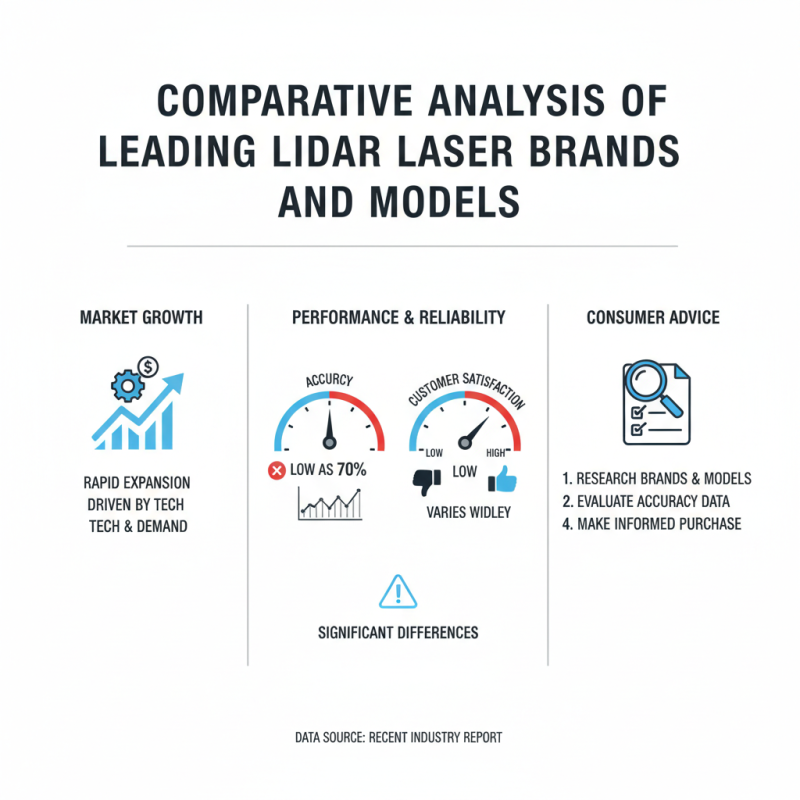
The global Lidar market is expanding rapidly, driven by advancements in technology and increased demand across various industries. A comparative analysis of leading Lidar brands reveals significant differences in performance and reliability. According to recent data, customer satisfaction rates for Lidar systems can vary widely, with some models scoring as low as 70% on accuracy tests. Consumers should weigh these factors carefully before making a purchase.
One major aspect to consider is the range and resolution of the Lidar systems. Studies indicate that Lidar units with longer ranges tend to perform better in larger-scale mapping projects. A report from industry experts shows that brands with resolutions above 5 cm are preferred for precision tasks. Additionally, look for systems that offer versatile scanning modes for different applications, which can enhance overall efficiency.
Tips: Always check for post-purchase support. Many users report frustrations due to inadequate customer service. Ensure you understand the warranty and maintenance options. Performance metrics can’t be overlooked. Before a purchase, seek out comparative reviews and test data to inform your decision, as not all products will live up to their advertised potential.
Innovative Features and Advancements in Lidar Technology
Lidar technology has seen significant advancements in recent years. These innovations are transforming how industries utilize 3D mapping. High-resolution sensors now provide more accurate data. This precision improves applications in agriculture, construction, and urban planning.
Many systems now feature real-time data processing. This capability speeds up decision-making. Enhanced scanning ranges also allow for broader coverage. Users can scan large areas quickly. Some systems even work in adverse weather conditions, which was a previous limitation.
Yet, challenges remain. The cost of implementing advanced lidar systems can be high. Additionally, not all regions have access to the latest technology. Educating potential users on lidar benefits is crucial. Improving user interface designs could also increase adoption. Reliable data collection remains a work in progress. Reducing complexity while increasing accuracy is essential as the technology evolves.
Cost-Benefit Evaluation for Global Buyers of Lidar Systems
Cost-benefit evaluation is crucial for global buyers considering Lidar systems. The technology landscape varies significantly, impacting overall project costs. A recent industry report estimates that Lidar technology can reduce survey and mapping costs by up to 50%. This value proposition is compelling for organizations looking to optimize budgets. However, total ownership costs include setup, software, maintenance, and training.
Investing in Lidar systems involves weighing immediate costs against long-term benefits. Buyers should assess project scope and scale. For instance, smaller projects may not justify high-end Lidar solutions, as cheaper alternatives can suffice. A study shows that 30% of Lidar users report underutilization of features, leading to potential inefficiencies. Market insights reveal that the ROI often aligns with industry standards; a well-selected system can yield positive returns within three years.
Global buyers must evaluate their specific needs and potential operational gaps within their teams. Often, the training and integration phases cause delays, which can hamper efficacy. Adapting to new technology is not always seamless, and organizations may face friction among stakeholders. Such factors mean that while the technology has its merits, buyers should reflect on their readiness for change and plan accordingly.
Cost-Benefit Evaluation of Lidar Technologies
This chart illustrates the cost and performance benefits of various Lidar technologies, providing a comparative overview for global buyers.